Thunder, Flush and Thomas Crapper: L
^UP^ to Thunder, Flush and Thomas Crapper index.
Chapters: A B C D E F G H I J K L M N O P R S T U V W Y Z
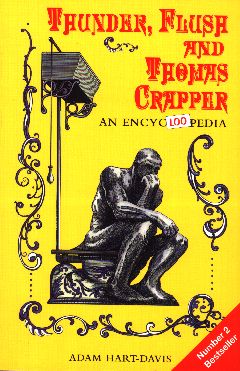
Extracts from Adam Hart-Davis's book.
(Buy the book from Micheal O'Mara Books, ISBN 1-85479-250-4, hardback 1-85479-245-8, or in the US, ISBN 1570760810.)
- Lavatory
-
 For at least 500 years a lavatory was a room for
washing, a basin, a bath, or a laundry.
For at least 500 years a lavatory was a room for
washing, a basin, a bath, or a laundry.
After about 1850 (OED) lavatory came to mean also a receptacle into which a person can urinate or defacate. In the sanitaryware business today, a lavatory is a wash-basin; a bowl for excretion is a closet; see euphemisms.
- Lighting-up Loo
-
Women are apparently irritated by
men leaving the seat up; so some bright spark in the USA has
invented a loo that lights up in the dark. When the infrared
sensor detects a person approaching, the light glows green if the
seat is down and red if it is up.
- Locks
-
The locks on lavatory doors---at least the kind with a rack and pinion that
moved a label to say ENGAGED when the lavatory was occupied---were invented
by Arthur Ashwell. He took out a patent in 1882 (No 781), and another, for
an improved version, in 1885 (No 6928). The improved mechanism was better
designed and easier to fit. Furthermore it not only incorporated a hidden
spring "which renders the action of the bolt smooth and noiseless", but
also allowed for notches to be included for locks on board sea-going
vessels to "remove the liability of the bolt to be shot or withdrawn by
the rolling of the vessel at sea".
- London
-
In 1995, according to the Evening Standard,
Greater London boasted 3,226,909 household lavatories, but
13,816 households had no inside toilet.
^UP^ to Thunder, Flush and Thomas Crapper index.
Text extracts from "Thunder, Flush and Thomas Crapper" copyright (c) Adam Hart-Davis 1997. Web extracts first published 2007-07-18, updated ✎2023-09-01
Images available from the DHD Multimedia Gallery.
Site content copyright (c) Damon Hart-Davis 1997--2018 unless otherwise stated.
Hosted by ExNet.
Text extracts from "Thunder, Flush and Thomas Crapper" copyright (c) Adam Hart-Davis 1997. Web extracts first published 2007-07-18, updated ✎2023-09-01
Images available from the DHD Multimedia Gallery.
Site content copyright (c) Damon Hart-Davis 1997--2018 unless otherwise stated.
Hosted by ExNet.